


 Print
Print


Southern African Natural Gas Advisory Service Service
Liquefied Natural Gas (LNG)
The global liquefied natural gas (LNG) industry has expanded rapidly in recent years and continues to achieve sustained growth. LNG is created by the application of a liquefaction process to natural gas that cools it to approximately minus 162 ' centigrade (minus 260' Fahrenheit).
With its low density it is not easy to store natural gas or to transport it in containers by vehicle. However with the advent of large scale commercial natural gas liquefaction and regasification plants, dramatic reductions in the density of gas can be achieved. When natural gas is liquefied it occupies in the liquid state 600 times less volume than when in the equivalent gaseous state. A single cubic metre of LNG is roughly equivalent to 600 cubic metres of gaseous natural gas.
These dramatic technological developments have enabled LNG to be cost effectively and safely transported in large quantities over long distances where there are not pipelines available. Dedicated cryogenic LNG sea vessels and cryogenic road and rail tankers are used for this purpose.

LNG terminals and trade
Across the world there some 24 major LNG liquefaction export terminals, more than 200 LNG storage facilities and more than 100 LNG import terminals specially designed and equipped to receive LNG bulk shipments. In 2011 some 297.3 billion cubic metres of LNG were shipped around the world with Japan alone importing 94 billion cubic metres. With more than 40 LNG import terminals, Japan has not had a major safety incident with LNG since it started receiving LNG imports 35 years ago.

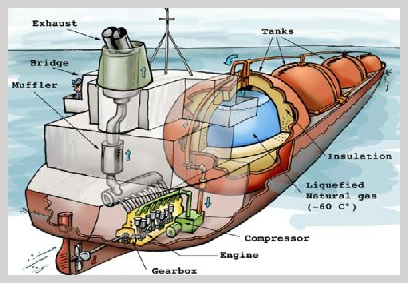
Regasification
Regasification typically takes place at LNG terminals located on the coast. It is offloaded from bulk LNG vessels and stored in insulated tanks at atmospheric pressure and a temperature of minus 160'c. The LNG is fed into the regasification plant where it is warmed to a temperature where it reverts to being gaseous natural gas. The heat to re-gasify the LNG in coastal LNG reception terminals is generally provided by sea water, at its ambient temperature and from turbine flue gases from an energy recovery system.
Open rack vaporizers consist of vertical aluminium tubes arranged in racks. The LNG flows up the inside of the tubes warming up and boiling off as gas. Sea water pours down the outside of the vaporizer tubes providing the heat to re-gasify the LNG. Heat recovery vaporizers are also used that deploy heat captured from power generation turbines at the terminal that would otherwise be lost. Such a system improves the overall energy efficiency of the regasification process. After the regasification process the natural gas is sent through a pipeline to the national gas supply network.
LNG safety in the world today
Natural gas as LNG is not new and it has been transported and stored in this form for more than 50 years. There have been some LNG accidents although not in recent years as the technology and necessary safety procedures have become more efficient. Today, thousands of sea miles are covered every year by bulk LNG sea vessels without incident. LNG ships have a double hull and are heavily insulated with extensive cargo safety systems. LNG is also not stored under pressure.
An LNG spill would not leave any residue as it would evaporate. In water LNG is also insoluble and would evaporate avoiding any surface based environmental damage. In its liquid state, LNG is not flammable so it will not burn or explode. Like other fuels when it vaporizes and mixes with oxygen it becomes flammable if exposed to a source of ignition. However the flammability range of vaporized LNG is limited. If the amount of natural gas in the air is less that 5% or greater than 15% it will not ignite.
The term ' gas supply train ' may also be used to describe the series of steps from natural gas production to end user, which is typically as follows:
Liquefaction
The liquefaction and purification processes in a liquefied natural gas plant are referred to as an "LNG train'. With the impurities contained in raw natural gas these have to be removed before it is cooled to cryogenic temperatures. LNG liquefaction plants typically consist of a number of trains to compress the purified natural gas into liquefied natural gas. Such a train will consist of a series of compression processes with propane, ethane and methane condensing. The whole LNG train also involves strict safety procedures at each stage in the liquefaction process because of the flammable nature of the gas being processed.
Cryogenics is the branch of physics that studies the production of very low temperatures (typically minus 150' C or 240' F) and how matter behaves at such temperatures.